Table of Contents
The Ironic Side of Artificial Intelligence
Artificial Intelligence (AI) has become an integral part of our daily lives. From self-driving cars to voice assistants and creative tools, AI systems are designed to make tasks faster, easier, and more efficient. Yet, amid this brilliance, we sometimes encounter moments of sheer absurdity—when smart technology acts… well, incredibly silly.
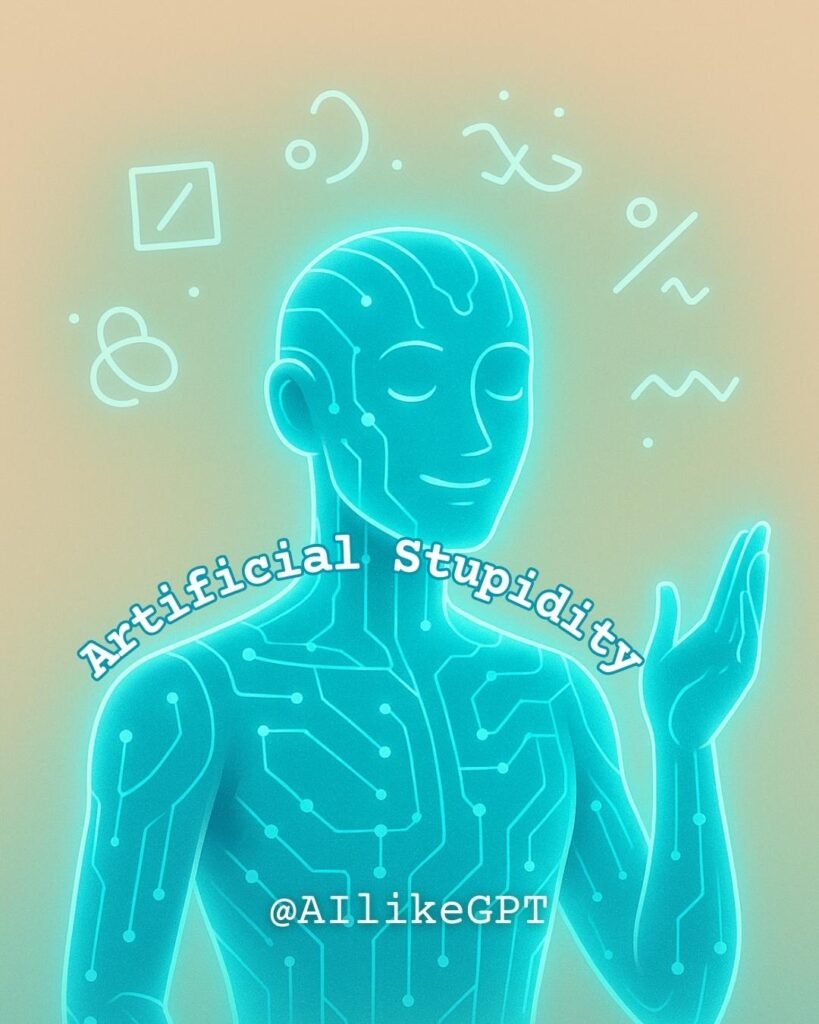
This phenomenon has earned a tongue-in-cheek name: Artificial Stupidity. It captures those laugh-out-loud but thought-provoking moments when sophisticated algorithms misidentify, miscalculate, or completely misunderstand the task at hand. Beyond the humor, these errors reveal deeper truths about the strengths and weaknesses of AI—and why humans still play an essential role.
What Is Artificial Stupidity?
Definition and Origins of the Term
Artificial Stupidity refers to the comically bad errors produced by advanced AI systems. Unlike random glitches, these mistakes occur because AI is following its programming too literally, applying learned rules without true understanding.
The term emerged as a satirical counterpart to Artificial Intelligence, reminding us that machines may be “smart,” but they lack human-level common sense.
Funny Yet Serious Examples of AI Gone Wrong
- A facial recognition system that mistakes a mop for a human head.
- A chatbot confidently claiming that 2 + 2 equals 5.
- An image classifier labeling a blueberry muffin as a Chihuahua.
These may sound trivial, but they expose important limitations in how AI processes information.

The Psychology of Trusting Machines
Why We Expect Perfection from AI
Humans have long associated machines with precision. A calculator doesn’t make math errors, so why should an AI assistant? This expectation of flawlessness makes AI mistakes feel more shocking and amusing.
The “Smart Tech” Illusion
Marketing often frames AI as near-magical—capable of solving problems beyond human reach. When reality fails to match the hype, Artificial Stupidity becomes a reality check, reminding us that AI is just a tool, not an oracle.
Why Does Artificial Stupidity Happen?
Data Gaps and Biased Training Sets
AI learns from data. If that data is incomplete, skewed, or biased, the model will produce flawed outcomes. For instance, a poorly trained medical AI might misdiagnose rare conditions simply because it never “saw” enough examples during training.
Overconfidence in AI Predictions
AI systems are designed to provide answers, even when uncertain. This leads to bizarrely confident wrong answers—a hallmark of Artificial Stupidity.
Struggles with Context and Nuance
Humans effortlessly understand sarcasm, irony, or cultural references. Machines? Not so much. Without common sense, AI can misinterpret even simple requests.
The Problem of Overfitting and Narrow Intelligence
AI often excels in narrow tasks but struggles outside its domain. A chess-playing AI won’t help you write a poem, and a language model may misinterpret math problems. This specialization creates blind spots that manifest as silly mistakes.
The Hidden Lessons Behind AI Mistakes
Why “Stupid” Errors Are Actually Valuable
While it’s easy to laugh at Artificial Stupidity, these mistakes often serve as critical learning opportunities. Each failure highlights a gap in an AI’s training data, design, or assumptions. Developers can analyze these errors to improve future systems, making them more reliable and trustworthy.
For example, when a voice assistant misinterprets accents or dialects, it reveals a lack of linguistic diversity in its dataset. By addressing such blind spots, developers can expand inclusivity and performance.

What They Teach Us About Human Intelligence
Artificial Stupidity doesn’t just expose machine flaws—it also underscores the remarkable adaptability of the human brain. Unlike AI, we can interpret nuance, apply common sense, and navigate ambiguity. Each AI blunder is a reminder of human superiority in creativity, judgment, and empathy.
Risks of Ignoring Artificial Stupidity
Automation Bias and Blind Trust
Humans often defer to machines, assuming they’re more accurate. This is known as automation bias. If people trust AI blindly—without questioning its mistakes—they risk making poor decisions, especially in healthcare, law, or finance.
Ethical Dilemmas in High-Stakes AI Systems
In areas like criminal justice or autonomous warfare, Artificial Stupidity isn’t funny—it’s dangerous. An error in facial recognition could lead to wrongful arrests. A misclassification in medical AI could cost lives. Recognizing these risks is crucial for responsible adoption.
The Role of Human Oversight
Why Humans Are Still Needed in the AI Loop
Despite rapid progress, AI cannot fully replace human judgment. Doctors, teachers, and engineers must remain involved to interpret, validate, and challenge AI outputs. Humans provide context and empathy—things machines simply lack.
Examples of Successful Human-AI Collaboration
- Medical Imaging: AI helps scan thousands of images quickly, but doctors confirm diagnoses.
- Creative Writing: AI tools generate drafts, while humans refine the tone and message.
- Self-Driving Cars: Autonomous features assist drivers, but humans must stay ready to intervene.
These partnerships show that the smartest systems emerge when humans and AI work together.
Turning Artificial Stupidity into Progress
How Developers Learn from AI Mistakes
Artificial Stupidity often drives innovation. When systems fail, developers refine algorithms, retrain models, and build safeguards. Each silly moment is an opportunity for technological growth.
The Push Toward Explainable AI
One major challenge with AI is its “black box” nature—users don’t always know how it reached a decision. To reduce Artificial Stupidity, researchers are working on Explainable AI (XAI), which makes machine reasoning more transparent. This helps humans understand, trust, and improve AI systems.
Artificial Stupidity vs. Artificial Intelligence
Two Sides of the Same Coin
Artificial Intelligence and Artificial Stupidity are inseparable. Every advancement in AI carries the risk of new, unexpected errors. Rather than seeing them as opposites, it’s better to view Artificial Stupidity as a natural part of AI evolution.
Finding Balance Between Optimism and Caution
While it’s tempting to either overhype AI or dismiss it entirely, the truth lies in balance. Acknowledging Artificial Stupidity keeps expectations realistic and prevents overreliance, while still appreciating AI’s transformative power.

Future of AI: Smarter, But Never Perfect
Will Artificial Stupidity Ever Disappear?
Probably not. As long as AI lacks true consciousness and common sense, mistakes are inevitable. Machines can get faster, more accurate, and more adaptable, but they will never think exactly like humans.
Why “Silly AI” May Always Be with Us
Humorously enough, Artificial Stupidity may never go away—and that’s okay. It serves as a reminder that technology is a tool, not a replacement for human wisdom. In fact, future generations may continue to laugh at AI errors as part of its learning curve.
FAQs About Artificial Stupidity
What exactly is Artificial Stupidity?
Artificial Stupidity refers to the funny, bizarre, or dangerous mistakes AI systems make when they misinterpret data, lack context, or apply rules too literally.
Is Artificial Stupidity dangerous?
It depends. In casual contexts, it’s just amusing. But in critical systems like healthcare or transportation, these mistakes can pose serious risks.
Can Artificial Stupidity be prevented?
Not entirely. Developers can reduce errors with better data and design, but some level of misunderstanding is inevitable.
Why do people laugh at AI fails?
Because they highlight the gap between expectation and reality. We expect AI to be smarter than us, so when it makes silly mistakes, it feels ironic and entertaining.
Does Artificial Stupidity mean AI is useless?
Not at all. AI is powerful and valuable, but its mistakes remind us to use it wisely, with human oversight.
What’s the difference between Artificial Stupidity and regular software bugs?
Bugs are coding errors, while Artificial Stupidity arises from the way AI learns and generalizes from data. It’s less about broken code and more about flawed reasoning.
Conclusion: Laugh, Learn, and Stay Critical
Artificial Stupidity may make us laugh, but it also makes us think. Every silly mistake—whether it’s a chatbot giving absurd answers or an image classifier confusing cats with toasters—reveals the limits of machine intelligence.
Instead of dismissing these failures, we should embrace them as opportunities to learn, improve, and reflect on what makes human intelligence unique. AI may be powerful, but it will always need guidance. By staying critical, cautious, and creative, we ensure that technology remains our helper—not our replacement.